Why pre-arrival preparation matters
A conference group is rarely “everyone checks in at the desk one by one.” Many hotels stage the group ahead of time: keycard holders on a table, names visible, keys clipped behind the paper. Guests walk up after their session (or when the bus arrives) and pick their own holder.
That table is often the first hospitality touchpoint of the stay. Guests may already be in the building for the conference, but this is where they meet the hotel side of the visit: their name, their room, their key. Crooked stickers, uneven handwriting, or a missing name show up immediately. An orderly table that looks readable and consistent stands out just as clearly.
For the best guest experience, that moment should feel smooth: the right name, easy to find, no extra desk pressure when the group arrives at the same time as other guests checking in on their own. The names are already in MEWS (or another PMS). The work is getting them onto the holders before the rush, without stickers or handwriting if you can avoid it.
What is key staging?
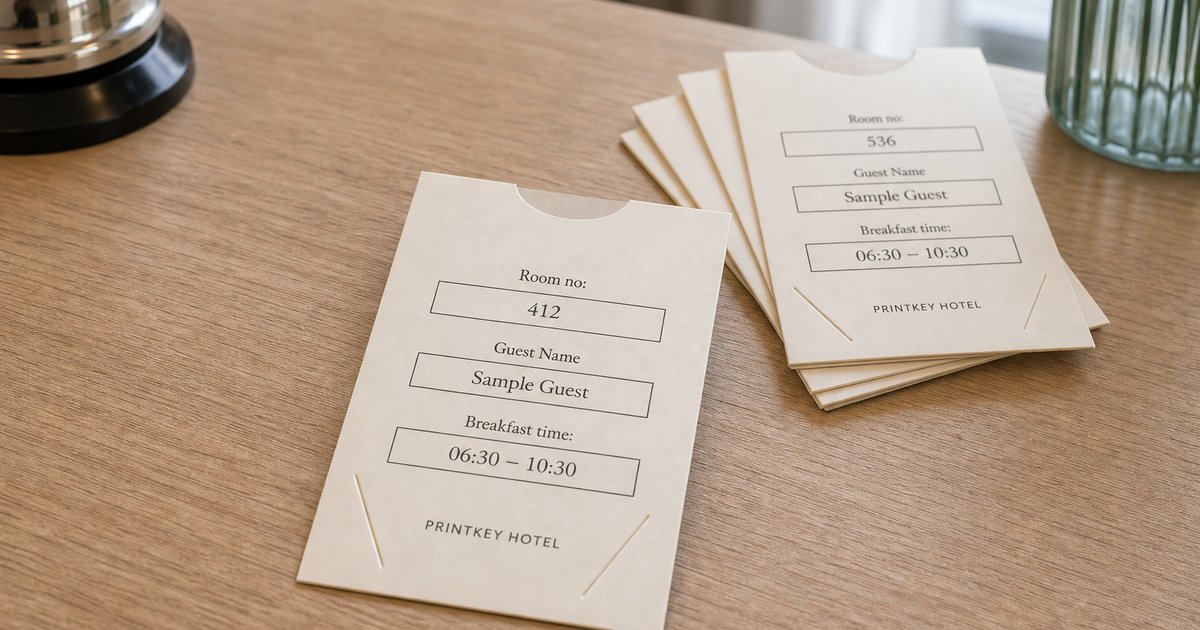
Key staging is preparing a whole group’s keycard holders before pickup: names on the holders, keys clipped in, laid out on a table (or in a tray) so guests can find their room.
It is not the same as encoding keys in the PMS, and it is not full check-in (payment, ID, registration). Key staging is the physical prep so the group can move through arrival without the desk writing fifty names under pressure.
Hotels rarely use that term out loud. On the floor it sounds more like: “Is the Ericsson group printed?” or “Are the keys on the table?”
Typical timeline before the group arrives
Timing depends on the property, but conference hotels often follow a pattern like this:
- Rooming list and rooms are confirmed in the PMS (often the day before).
- Night shift (or late evening) stages the holders in PrintKey: paste the MEWS group export, print the labels, then clip keys and lay the set out for pickup.
- Day shift hands the table (or points guests to it) when the group arrives.
Without PrintKey, that same night slot is still stickers or handwriting. The job is the same: names on holders before the rush. PrintKey is the print step that makes it repeatable for whoever is on shift.
If night prep does not happen (sick leave, agency cover who do not know the task, or a late rooming list), the work lands on day shift. That is usually the worst moment: phones, walk-ins, and a conference group at the same time.
Room status and when you print
Housekeeping status changes the job. Early in the day many rooms are still Dirty. Later, often closer to arrival, more rooms are Inspected (or Ready). That matters if you put the room number on the holder.
A practical approach some MEWS hotels use:
- Print the whole group for names (and breakfast if you use it) once the list is stable.
- Put the room number only on rooms that are already inspected. Dirty rooms still get a holder with the guest name, but no room number yet, so you are not guessing or writing a number that will change.
- As more rooms become inspected, those holders can go out with room numbers included. Late in the process, most of the group may already be printable with room numbers in one run, with fewer handwritten add-ons at the last minute.
That is why “only inspected room numbers” is not a side detail. It lets you start key staging before every room is ready, without reprinting the whole table or copying numbers by hand for rooms that are still Dirty.
Common workflows at the front desk
Most properties still use one of three approaches for names on holders:
Handwriting
Staff copy names from the screen or a printout onto each holder. It needs no extra tools. It is slow on large groups, and international names are easy to misspell. Quality varies by person and by how late in the shift it is.
Stickers and mail-merge tools
Some hotels export a list, build labels in a spreadsheet or a Google Docs / Sheets label add-on, print sticker sheets, then stick each label onto a holder. The print step can look modern; the sticking step is still manual. For roughly 100 arrivals, that whole chain often takes in the order of 45–90 minutes, depending on the team and how clean the list is.
Direct print onto the holder insert
Other hotels print the name block straight onto the paper that sits in the keycard holder (room number, guest name, breakfast time where used), then clip the key behind it. The goal is the same as stickers: readable, consistent names, with fewer hand steps after the list leaves the PMS.
Typical ranges for about 100 arrivals (not a guarantee; teams and list quality differ):
- Stickers + sticking: often 45–90 minutes
- Handwriting: often 60–120 minutes
- Paste from PMS export → print run: often 10–25 minutes for the print step, then clipping keys and laying out the table
Where PrintKey fits
PrintKey is built for that third path: paste a MEWS export in the browser, review the cleaned guest list, choose room-number and breakfast options, then print A7 holder labels for the whole group. Guest lists stay on the front desk computer during prep. They are not uploaded to a PrintKey cloud database.
If your team still peels sticker sheets or retypes names by hand, PrintKey is one practical way to move from “list in MEWS” to “holders on the table” without a separate mail-merge chain. It will not replace encoding keys or full check-in; it focuses on the label prep step that usually sits between those two.
What good preparation looks like
A ready conference set usually has these traits:
- Every holder has a clear guest name (and room number if you use it).
- Names match the PMS spelling, especially for international guests.
- Keys are clipped the same way on every holder (behind the paper, using the top flap and corner slits).
- The layout on the table is findable (alpha order, or by subgroup).
- Breakfast times, if printed, match what the hotel actually serves that day.
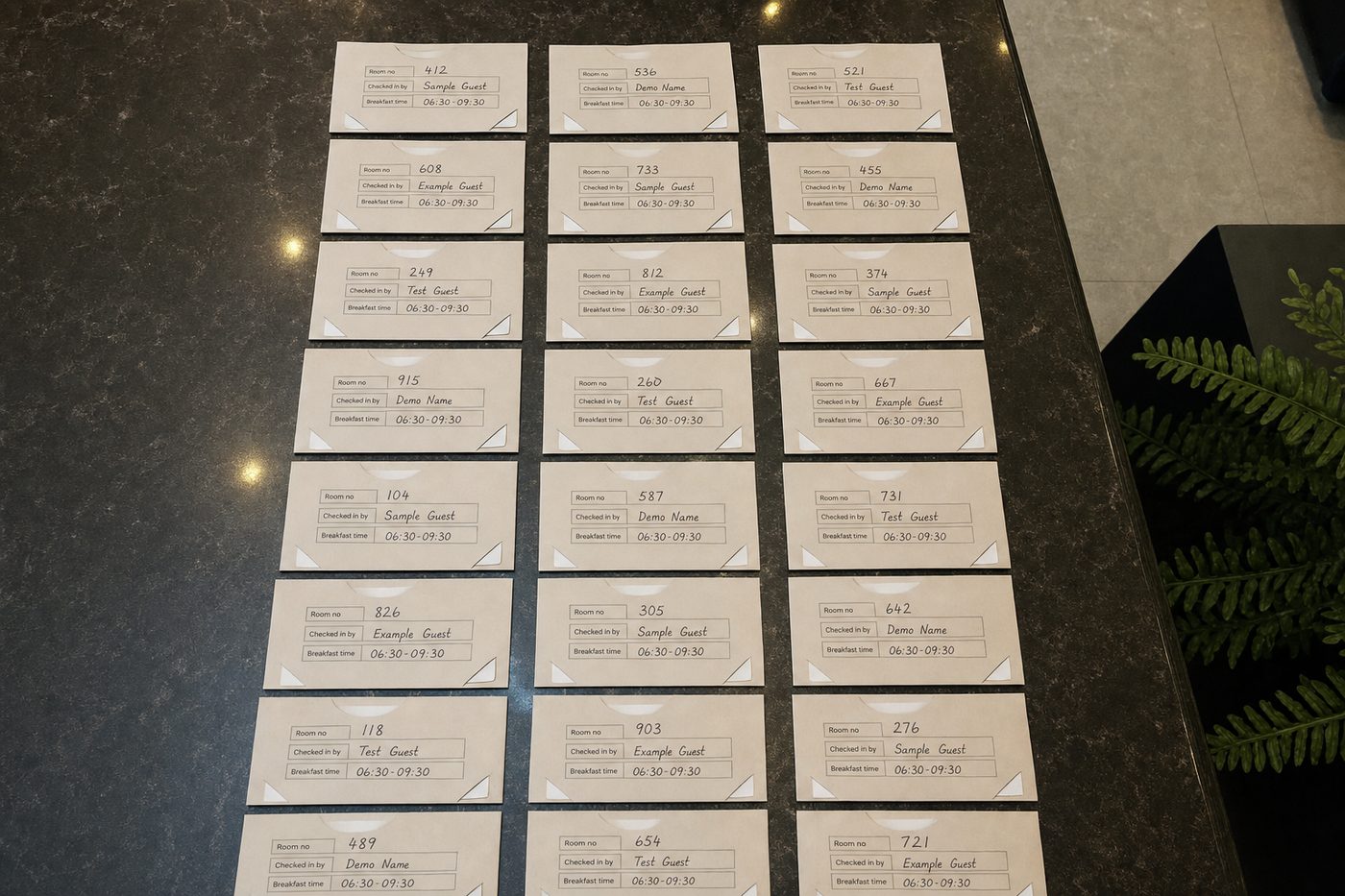
Good prep is also resilient: if the usual night person is off, a colleague can still finish the group without reinventing the process. That is why short, repeatable steps beat a one-off Excel file that only one person understands.
When prep slips onto the day shift
This is the stress case. The group is due, the table is empty, and reception is already busy. Teams then rush handwriting or skip staging and check people in one by one. That is slower for guests and harder on the desk.
Properties that can finish printing quickly sometimes wait longer before they start, because they know the run itself is short. That only works if the workflow is reliable and staff know how to start it. If the only backup is an old spreadsheet, people fall back to pen and paper under pressure.